


I saw this many more times than I wanted (and I bet you did too):
An OR Engineer starts in a new company. In a couple of months, they have an algorithm to solve an optimization problem. It’s not perfect, but it works, so they look for refinement. After some iterations, solutions seem ideal. But when going to real users, no one wanted the tool.
I didn’t just see this pattern in others. I felt it in my skin. It’s frustrating.
Though this is not a time to regret, I now firmly believe that’s not the way to succeed in Operations Research.
Today, I’ll share why becoming a Product OR Engineer is the key objective for Operations Research professionals aiming to create solutions that deliver genuine business value and user delight.
Today’s agenda in Feasible will cover:
🔧 What does being a Product OR Engineer mean?
🔥 Why are Product OR Engineers on the rise?
👥 How User-Driven Development becomes your advantage
I’ll give you examples of that last part, including a story from my team a year ago.
Ready? Let’s dive in… 🪂

🔧 What does being a Product OR Engineer mean?
Traditionally, OR professionals like us have excelled at solving complex mathematical problems.
It’s normal; we’ve been trained for that.
Yet, these mathematically and algorithmically elegant solutions often don’t resonate with users, don’t get stakeholder buy-in, and fail to integrate into business processes. It’s unfortunate because you want to deliver value but can’t find a way.
We understand the connection between our optimization engine and software development, but not with a product. Without a product, we’ll struggle to deliver our solution.
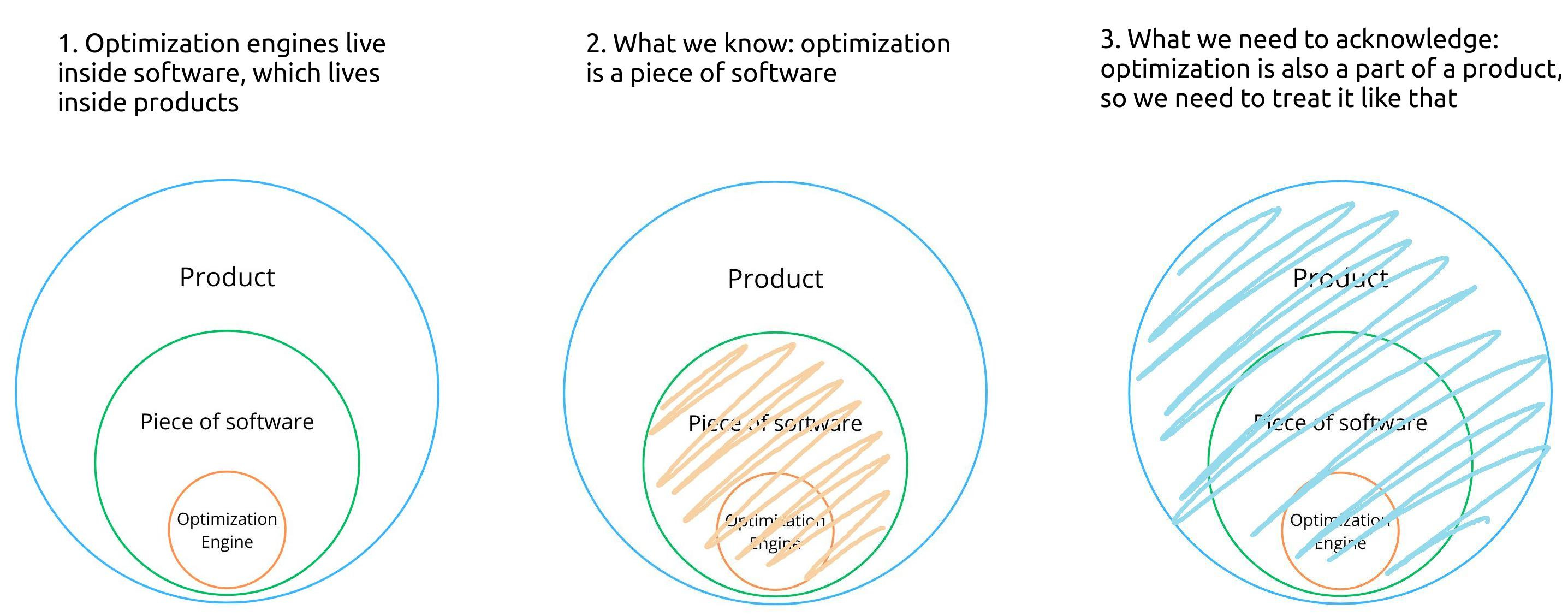
We need to develop solutions for business problems within a product.
You can own the entire solution lifecycle, from problem identification with stakeholders to deployment and continuous improvement.
(And now you realized -as I just did while writing- that I’m repeating a word: product, product, product.)
A Product OR Engineer merges technical OR expertise with a strong product mindset. In that role, you will:
